
Matiaburj

“Hi, can you please tell me how I can get to Matiaburj”, I asked the receptionist of our hotel in Calcutta.
“Sorry, where?”
“Matiaburj, you know, the locality”?
“I think you mean, Metiabruz, sir”, he said with a grin.
“No, I mean Matia-burj”, I said with a forced chuckle to blunt the confrontational tone.
“Right, of course, sir”, he smiled. The concession was the insincere grace of hospitality which came from his training and it annoyed me.
Then he said, “So Metiabruz is at the other end of the city, sir. It’s a long commute and there’s no direct bus. I would suggest you take a cab”.
I thanked him and did as he said, booking a cab for mum and me. We were heading here because this is where Wajid Ali Shah and his son Prince Birjis Qadr are buried. Metiabruz got its name from the Urdu speakers of Wajid Ali Shah’s retinue from Lucknow who called the area Matiaburj after an earthen pillar that once stood there as we had learnt from Rosie Llewellyn Jones’ book on the Nawab. Matia –mud and burj – tower. The Brits couldn’t do the retroflex ‘t’ in the word and made it Metiabruz and in North India, retroflex sounds start disappearing as you travel east of Lucknow. In Bihar, the Hindi/Urdu word ‘Thōṛā(little)’ loses its retroflex sound becoming ‘Thōrā’ and by the time you reach Bengal and Assam, the vanishing act is complete. Nor did they like the affricate at the end of ‘burj’, which meant that Bengalis also preferred the British way of pronouncing the name.
When Wajid Ali Shah had been deposed by the British in 1856, he was made to leave Lucknow. This was standard British practice. Native rulers who they disliked were deposed and exiled from their power base so that they could never threaten them again with their legitimacy. The last Peshwa was exiled from Pune to Bithur close to Kanpur, the King of Burma to Ratnagiri, Bahadur Shah Zafar to Burma and Wajid Ali Shah to Calcutta. While leaving he wrote a famous Urdu couplet on seeing Lucknow for the last time
दर-ओ-दीवार पे हसरत से नज़र करते हैं
ख़ुश रहो अहल-ए-वतन हम तो सफ़र करते हैं“I look at these doors and walls with longing —
Farewell, people of my homeland, I must travel now.”
An accomplished artist, he also composed the Thumri Babul Mora Naihar Chooto Jai in Awadhi where he compares his exile from Lucknow with a bride leaving her home. Many Hindustani classical singers have added it to their repertoire because while most Viraha (separation) Thumris talk about the loss of being separated from the beloved, Wajid Ali Shah harnessed it to express the pain of being uprooted.
But unlike the other exiled kings, when he left, he took a huge entourage with him. It consisted of his wives, concubines, women of the zenana, their families, poets, writers, musicians, singers, kathak dancers, painters, calligraphers, cooks, barbers, tailors, perfumers, halwais, imams, qazis, animal handlers and a number of other folk. The total number was probably over ten thousand people, all subsisting on the annual pension of 12 lakh rupees that the British promised him.
They settled down in a semi-rural landscape with an earthen tower. They were brought here so that the British could keep an eye on Wajid Ali Shah who remained popular in the restive Awadh. With his retinue and pension, Wajid Ali Shah cocooned himself from the British in this microcosm of Lucknow at the southern edge of Calcutta on the Hooghly. Had the Nawab died soon after, it is possible that the hive he created wouldn’t have outlived the death of its queen bee. But the obese Nawab gave the British actuaries a run for their money and lived in Matiaburj for thirty years, making demands for increments in his pension to keep up with inflation. In those three decades Matiaburj was able to grow roots; a city within a city, an island of Lucknow near the Bay of Bengal.
The moment our cab rolled into the busy streets of Matiaburj, we felt we were in the Nakhkhas market of Lucknow. It had the same bustle and everyone here spoke in Lakhnavi Urdu even after a hundred and seventy years. We asked for directions to the Sibtainabad Imambara built by Wajid Ali Shah for his burial. The entrance had three concentric foliated arches, a familiar staple of old Lucknow architecture. Two fish, the symbol of the Awadh Nawabs, were carved on either side above them. A couple of mermaids held a crown on the gate to tell us that Awadhi royalty lay here. We couldn’t help comparing the small structure to the immense Bara Imambara in Lucknow where the third Nawab Asaf-ud-Daulah is buried. The Sibtainabad Imambarah was like other distributaries in the delta, a final petered out form of what had once been a large river in upstream Lucknow.
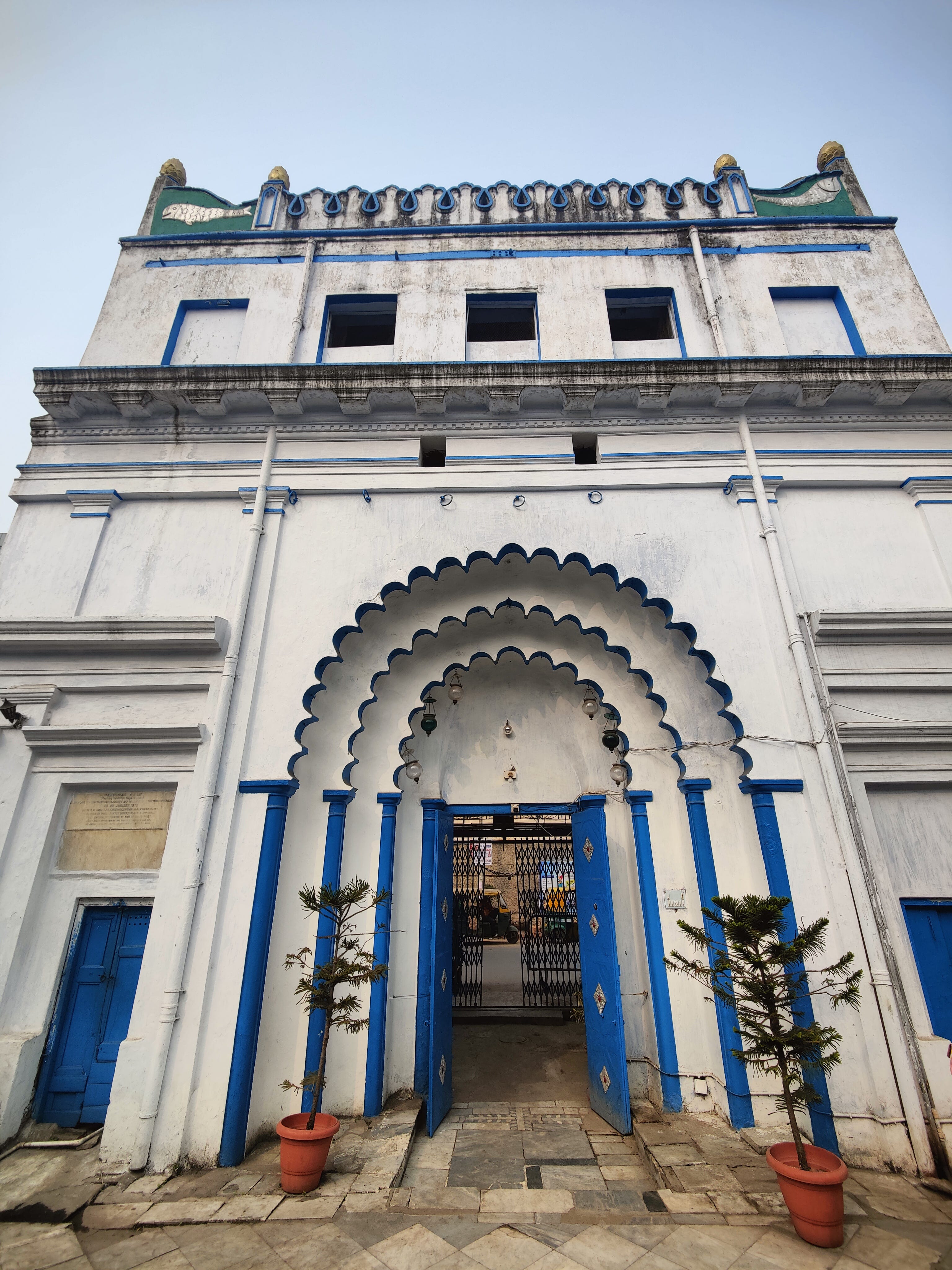
The walls had information on the trust established by his family to maintain the structure. One of the write-ups spoke of the recently deceased wife of Wajid’s Ali Shah’s great grandson Begum Mamlikat Badr. She had been from Lucknow and had spent her life after marriage in Calcutta. It said that she wanted to be buried in Lucknow and although she died during the pandemic, they ensured that her body made its way back even though very few flights were operating at the time. They made it a point to say that she at least did not suffer Wajid Ali Shah’s fate of being denied a burial at home.
This was a very specific kind of trauma. When the last Mughal king Bahadur Shah Zafar was at death’s door in Burma, he wrote
कितना है बद-नसीब ‘ज़फ़र’ दफ़्न के लिए
दो गज़ ज़मीन भी न मिली कू-ए-यार में
“How wretched is Zafar’s fate —
he couldn’t even find two yards of earth in his homeland to be buried.”
In Matiaburj Wajid Ali Shah also wrote, as if in response
यही तशवीश शब-ओ-रोज़ है बंगाले में
लखनऊ फिर कभी दिखलाए मुक़द्दर मेरा
“The same sorrow haunts my days and nights in Bengal —
May fate show me Lucknow again.”
It wasn’t to be for either of them. Prince Birjis Qadr was also not allowed to return because during the uprising in 1857, he had been proclaimed Nawab of Lucknow by the rebels led by his mother Begum Hazrat Mahal. But the graves of Wajid Ali Shah’s descendants told me that they hadn’t returned to Lucknow even after the British left. In those ninety years, the Matiaburj version of Lucknow had become home and although they were buried next to Wajid Ali Shah, his fate had not been theirs. Nor had it been the fate of the descendants of the retinue. I spoke to the old caretaker of the shrine and a smart guy who had completed his studies and was helping with the trust. They spoke the Urdu of Lucknow but were also fluent in Bengali. On my request, they read aloud the Urdu inscriptions on the graves. I asked them for directions to the Panna Lal Chaurasiya paan shop which I had read claimed to have been started by the man who served the Nawab his paan.
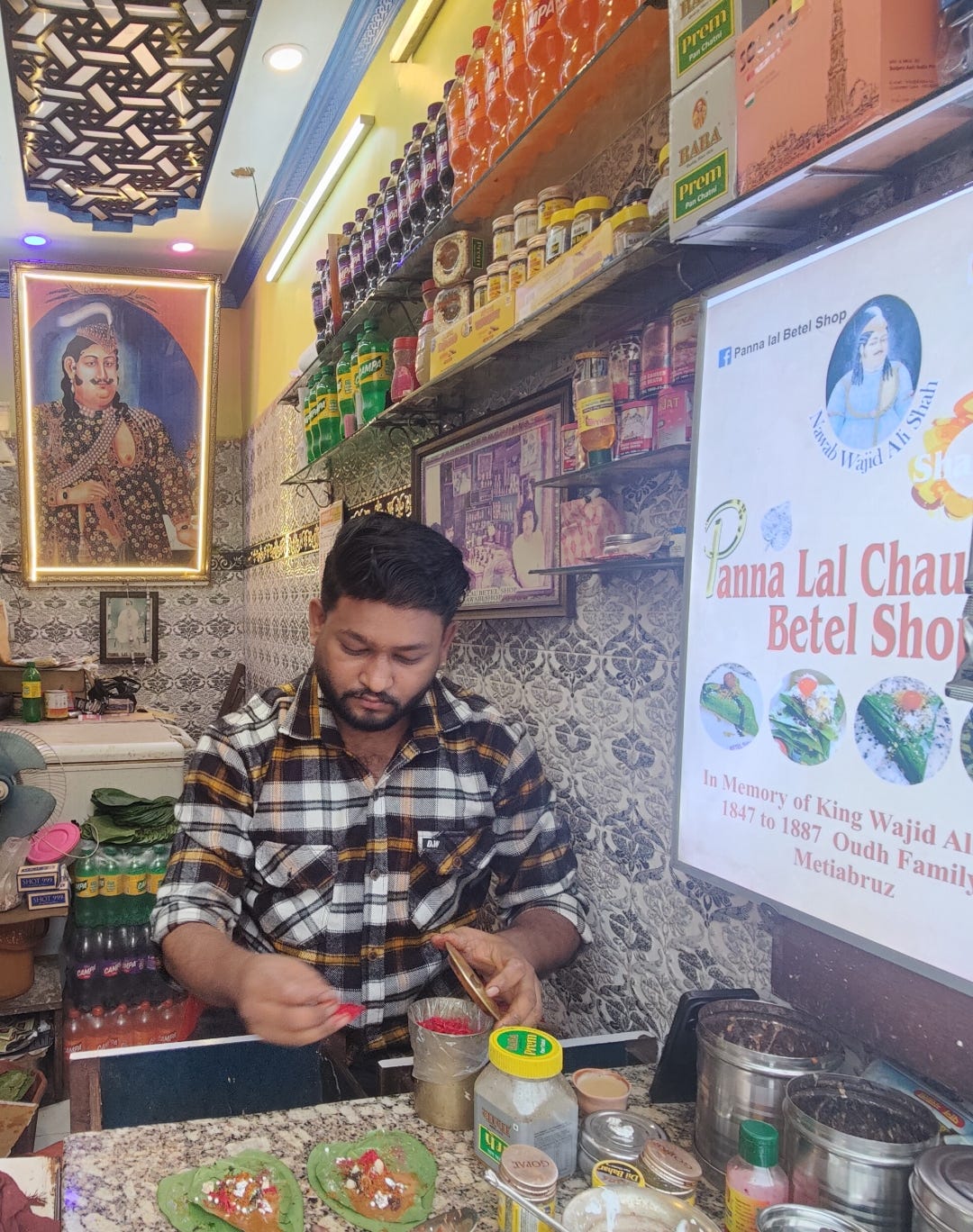
At the paan shop, we found a bearded young man asking us what kind of paan we wanted. It looked like any other paan shop except for a large portrait of Wajid Ali Shah and his exposed left nipple staring down at us in all regal finery. Ramesh Saini’s paan shop close by also had a similar portrait and story. Matiaburj gave Calcutta its Biryani, Kebabs, Rezalas and the kernel around which the city became a hub of Hindustani classical art as Thumris, Dadras, Ghazals and Kathak became popular starting with the musicians and courtesans that the Nawab brought with him. For playing a gracious host, Calcutta imbibed what it wanted from Matiaburj but Wajid Ali Shah’s fashion sense did not catch on. Nor did those retroflex sounds. To hear them in Calcutta, you’ll have to head to the city within it, where Hindu paanwallahs put up pictures of a Muslim man exposing his left nipple.
Lovely piece Ayush. So much history around us, we have barely scratched the surface I guess.
Such a delightful read! Next time I am in Bangalore, would love to explore Chikkujala with you, if you have not already.